





Latest Combiblock Machine for PET Bottling Lines: 2026 Price & Buying Guide
A complete guide to blow-fill-cap Combiblock technology, production capacities, beverage applications, equipment configurations, prices and purchasing considerations for modern PET bottling factories.
What Is a Combiblock Machine?
A Combiblock machine is an integrated PET bottling system that combines bottle blowing, beverage filling and bottle capping into one synchronized production unit. It is also known as a blow-fill-cap machine, blowing-filling-capping Combiblock, Combibloc or Combi Block.
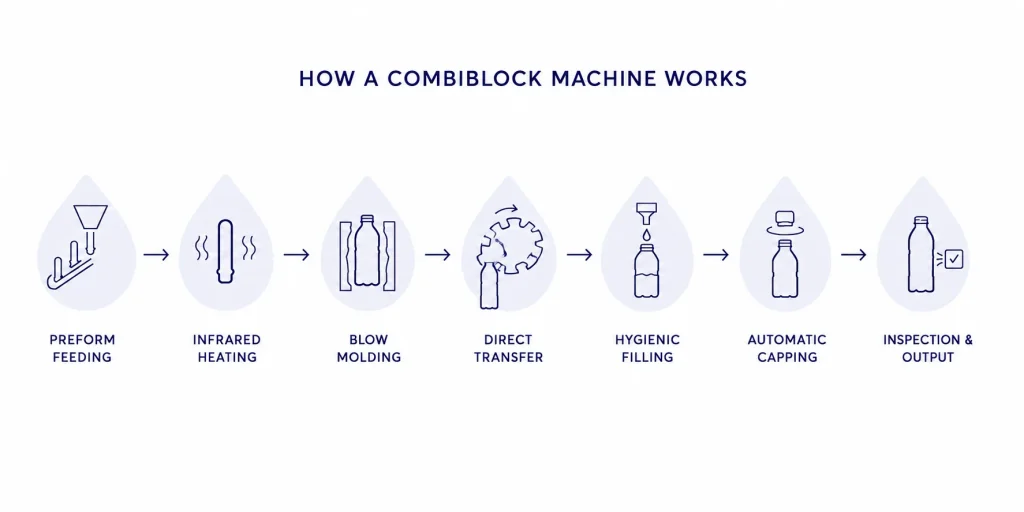
A Combiblock machine receives PET preforms, heats and stretches them into finished bottles, transfers the newly formed bottles directly to the filling section and immediately seals them with caps. By integrating these processes, the system reduces empty-bottle conveying, minimizes intermediate handling and creates a compact, highly automated PET bottling process.
Preform Heating
PET preforms are automatically fed into the heating oven and conditioned to the required forming temperature.
Bottle Blowing
Heated preforms are stretched and blown inside bottle molds using controlled high-pressure compressed air.
Product Filling
Newly formed bottles are transferred directly into the filling unit without a long empty-bottle air conveyor.
Bottle Capping
Filled bottles are immediately capped and discharged for labeling, inspection and final packaging.
Why Combiblock Technology Matters in 2026
Beverage manufacturers are increasingly evaluating complete production efficiency rather than only the rated speed of an individual filling machine. Factory footprint, empty-bottle handling, energy consumption, hygiene, automation and long-term operating costs all affect the real value of a PET bottling project.
A Combiblock solution is generally considered for medium- and high-capacity factories where synchronized production and reduced intermediate conveying can provide measurable operational advantages. However, it requires a higher initial investment and should be selected according to the actual beverage, bottle format, capacity and factory plan.
Download More Combiblock Machine Information
Contact Suncrown on WhatsApp to receive more information about combiblock machine specifications, production capacities, bottled water line configurations, factory layouts and budget quotations.
How Does a Combiblock Machine Work?
A Combiblock machine coordinates PET bottle forming, product filling and bottle capping through one integrated control system. Instead of operating as separate machines connected by a long empty-bottle conveyor, each production stage is mechanically and electronically synchronized.
One Continuous Process from PET Preform to Sealed Bottle
The process begins with PET preforms rather than finished empty bottles. Preforms are automatically fed into the heating section, formed into bottles inside dedicated molds and transferred directly to the filling unit through a controlled neck-handling system.
After filling, each bottle moves immediately into the capping section. The entire sequence is monitored by a central PLC and HMI system so that the blowing, transfer, filling and capping sections operate at a coordinated production speed.
PET Preform Feeding and Orientation
PET preforms are loaded into the preform hopper and automatically elevated, sorted and oriented before entering the heating system. Sensors monitor preform supply to maintain continuous production.
Controlled Infrared Preform Heating
Preforms pass through an infrared heating oven where multiple heating zones condition the PET material. Temperature distribution is adjusted according to the bottle design, preform weight, wall thickness and required material distribution.
Stretch Blow Molding
Heated preforms enter the rotary blowing unit. A stretch rod extends the material vertically while compressed air expands it against the mold cavity. The finished bottle shape is controlled by the mold, stretching profile, blowing pressure and cooling conditions.
Direct Bottle Transfer
Newly formed bottles are removed from the blowing molds and transferred directly by their neck rings. This controlled transfer eliminates the need for a long empty-bottle air conveyor between the blowing machine and filling machine.
Beverage Filling
Bottles enter the filling section and are filled using technology selected for the beverage. Still water may use gravity or flow-meter filling, carbonated drinks require isobaric filling, and juice applications may require hot-filling or aseptic configurations.
Cap Feeding and Capping
Caps are elevated, sorted and supplied to the capping unit. The capping heads apply controlled torque to seal each bottle before it leaves the enclosed Combiblock system.
Discharge, Inspection and Packaging
Sealed bottles are discharged to the downstream line. They may pass through filling-level, cap and bottle inspection before entering labeling, coding, packaging and palletizing equipment.
Why Direct Bottle Transfer Is Important
The direct transfer section is one of the main differences between a Combiblock and a traditional linear bottling line. Bottles remain under controlled handling from the blowing section to the filling section.
Bottles do not need to travel through a long air conveyor, accumulate in storage or be handled manually between machines.
Bottle production and filling speed are coordinated, helping maintain stable flow through the integrated system.
Controlled neck handling can reduce bottle-body contact, which may support the use of optimized lightweight PET bottle designs.
Centralized Control and Production Synchronization
A Combiblock is not simply several machines installed next to each other. The blowing, transfer, filling and capping modules must communicate through one coordinated automation system.
PLC and HMI Control
Operators can monitor production speed, temperatures, pressure, alarms and equipment status through the central control interface.
Servo Drive Coordination
Servo-controlled movements help coordinate preform handling, stretching, bottle transfer and other critical production actions.
Automatic Speed Matching
If one section changes speed or stops, upstream and downstream sections respond according to the programmed control sequence.
Alarm and Fault Diagnosis
Sensors and monitoring functions identify abnormal conditions to support faster troubleshooting and reduce unnecessary downtime.
The performance of a Combiblock depends on the coordination of every production stage—not only the rated speed of the filler.
Preform heating, bottle blowing, direct transfer, filling, capping, automation and supporting utilities must be correctly matched. For this reason, the machine should be configured according to the required beverage, bottle design, preform weight, production capacity and factory operating conditions.
Main Components of a Combiblock Machine
A combiblock machine is not simply a blow molding machine connected to a filler. It is a synchronized production platform that integrates preform handling, bottle blowing, neck-transfer, beverage filling, capping, inspection and centralized automation into one compact system.
What are the main components of a combiblock machine?
The main components include a preform feeding system, infrared heating oven, rotary stretch blow molding unit, high-pressure air system, neck-handling transfer starwheels, beverage filling carousel, cap feeding and capping system, PLC and HMI controls, inspection equipment, hygienic enclosure and CIP system. The exact configuration depends on the beverage, bottle design, production capacity and required hygiene level.
Integrated Combiblock System Architecture
Continuous Bottle FlowCore Modules and Their Functions
Every module affects bottle quality, filling accuracy, production efficiency and total operating cost. Buyers should therefore evaluate the complete system rather than comparing only nominal output.
Preform Feeding and Unscrambling System
PET preforms are loaded into a hopper, elevated and automatically oriented before entering the heating oven. Stable preform feeding is essential for maintaining continuous high-speed production.
- Automatic hopper and preform elevator
- Controlled preform sorting and orientation
- Neck-finish protection during transportation
- Low-level detection and feeding alarms
Infrared Heating Oven
The oven heats the PET body to the correct forming temperature while protecting the neck finish. Preforms rotate continuously to produce a controlled and uniform temperature profile.
- Multi-zone infrared temperature control
- Continuous preform rotation during heating
- Neck cooling to prevent finish deformation
- Recipe settings for different bottle formats
Rotary Stretch Blow Molding Unit
Heated preforms enter rotary molds where a stretching rod and high-pressure air form the final PET bottle. Blow timing, pressure and mold temperature directly influence bottle strength and material distribution.
- Servo-controlled stretching system
- Pre-blow and high-pressure blow stages
- Quick-change bottle molds
- Optimized bottle-wall thickness distribution
High-Pressure Air and Recovery System
Bottle blowing requires clean, dry compressed air at controlled pressure. An air-recovery system can reuse part of the exhaust air for lower-pressure machine functions, reducing utility consumption.
- High-pressure blowing-air distribution
- Pressure monitoring and safety protection
- Optional compressed-air recovery
- Reduced overall energy consumption
Neck-Handling Starwheel System
Newly formed bottles are supported by their neck rings and transferred directly from the blowing module to the filling carousel. This eliminates the need for a long empty-bottle air conveyor.
- Direct blow-to-fill bottle transfer
- Neck-ring handling instead of bottle-body contact
- Reduced risk of bottle deformation and contamination
- Synchronized high-speed rotary movement
Rotary Filling Carousel
The filling module delivers a controlled quantity of beverage into every bottle. Valve design, product temperature, pressure and hygiene configuration vary according to the beverage.
- High-accuracy electronic or mechanical filling
- Food-grade stainless-steel product contact parts
- Automatic product-level and pressure control
- Water, CSD, juice and sensitive beverage options
Cap Feeding and Capping System
Caps are elevated, sorted and delivered in the correct orientation to the capping turret. Each cap is positioned and tightened with controlled torque to protect product quality and package integrity.
- Automatic cap elevator and sorter
- Enclosed cap chute and delivery system
- Controlled capping torque
- Optional cap rinsing or sterilization
PLC, HMI and Servo Control System
A centralized automation platform synchronizes the blow molder, transfer starwheels, filler and capper. Operators can monitor operating conditions, alarms and production data from one HMI.
- Centralized recipe and parameter management
- Real-time production status monitoring
- Fault diagnosis and alarm records
- Servo synchronization between rotary modules
Bottle Inspection and Rejection System
Inspection devices identify defective preforms, bottles, filling levels and caps. Non-conforming containers can be rejected automatically before labeling and secondary packaging.
- Preform and bottle defect inspection
- Fill-level and cap-presence detection
- Automatic rejection of defective bottles
- Optional camera-based quality inspection
Enclosure, CIP and Protection Systems
Hygienic guarding separates sensitive production zones from the surrounding factory environment. Cleaning, sanitation and safety systems help maintain reliable production and protect operators.
- Enclosed clean production environment
- Automatic clean-in-place preparation
- Safety doors and interlock protection
- Drainage and hygienic surface design
The Filling Module Must Match the Beverage
A combiblock for still water cannot automatically be treated as identical to a line for carbonated drinks, hot-filled juice or sensitive beverages. Product properties determine filling technology, sanitation level and total investment.
What Buyers Should Check in Each Module
Two machines with the same rated speed may have different levels of efficiency, hygiene, automation and long-term operating cost.
| System | Key Evaluation Point | Why It Matters |
|---|---|---|
| Heating Oven | Temperature-zone control, neck cooling and heating uniformity | Influences bottle appearance, stability and PET material distribution. |
| Blowing Module | Stretching accuracy, air pressure and mold-change time | Affects bottle quality, energy use and production flexibility. |
| Transfer System | Neck-handling design and module synchronization | Determines transfer stability at high production speeds. |
| Système de remplissage | Filling principle, valve design and product-contact materials | Controls filling accuracy, hygiene and beverage compatibility. |
| Capping System | Cap delivery reliability and torque control | Protects seal integrity and reduces cap-related rejection. |
| Automation | PLC platform, diagnostics and spare-parts availability | Influences maintenance efficiency and long-term technical support. |
Before requesting a quotation, buyers should confirm the beverage type, bottle volume, bottle drawing, preform weight, neck finish, target BPH, cap specification, water analysis and packaging method. These details determine the machine modules, mold quantity, filling technology, utility requirements and final combiblock machine price.
What Beverages Can a Combiblock Machine Produce?
Combiblock technology can be configured for bottled water, carbonated soft drinks, juice, functional beverages and other liquid products. However, the filling principle, hygiene level, bottle design and process equipment must match the specific beverage.
Which beverages are suitable for a combiblock machine?
A PET combiblock machine is commonly used for still water, carbonated water, carbonated soft drinks, juice, tea, functional beverages and certain sensitive liquid products. Different beverages require different filling technologies: atmospheric or non-contact filling for water, isobaric filling for carbonated drinks, hot filling for heat-treated juice, and enhanced hygienic or aseptic systems for sensitive beverages.
Main Beverage Applications
The beverage formula determines the required filling method, product-contact system, sanitation process and PET bottle performance.
Bottled Water
Still ProductsBottled water is one of the most common applications for a blow-fill-cap combiblock. The system can produce lightweight PET bottles and transfer them directly into a hygienic filling environment, supporting high-speed production with reduced empty-bottle handling.
- Suitable for multiple PET bottle volumes
- Supports lightweight bottle production
- Reduced empty-bottle conveyor requirements
- Integrated hygienic filling environment
Carbonated Soft Drinks
Pressurized ProductsCarbonated soft drinks require pressure-resistant PET bottles and controlled isobaric filling. The machine must maintain product pressure and temperature to reduce foaming, CO₂ loss and inconsistent filling levels.
- Pressure-controlled product circulation
- Temperature management before filling
- Foam and product-loss reduction
- Pressure-resistant bottle base design
Juice, Tea & Functional Drinks
Hot-Fill ProductsJuice, tea and functional beverages may require hot filling to support product stability. The PET bottle must be designed to withstand filling temperature, internal vacuum and downstream cooling without excessive deformation.
- Heat-resistant PET bottle configuration
- Product-temperature monitoring
- Hot-product circulation capability
- Compatible downstream bottle cooling
Sensitive Beverages
Enhanced HygieneProducts with limited preservatives or high microbiological sensitivity require a more advanced hygienic design. Depending on the product and shelf-life objective, the project may need container sterilization, cap sterilization, clean-room protection or an aseptic filling configuration.
- Enhanced hygienic machine enclosure
- Bottle and cap sterilization options
- Controlled sterile production environment
- Automatic cleaning and sanitation programs
Combiblock Configuration by Beverage Type
The table below provides a general configuration reference. Final engineering must be based on the product formula, shelf-life target and local food-safety requirements.
| Beverage | Filling Principle | Bottle Requirement | Hygiene Level | Typical Configuration |
|---|---|---|---|---|
| Still Water | Gravity or non-contact | Lightweight standard PET bottle | Hygienic | Standard Combiblock |
| Sparkling Water | Isobaric | Pressure-resistant PET bottle | Hygienic | CSD Combiblock |
| Carbonated Soft Drinks | Isobaric | Pressure-resistant petaloid base | Hygienic | CSD Combiblock |
| Juice and Tea | Hot fill or controlled temperature | Heat-resistant PET bottle | Enhanced hygienic | Hot-Fill Combiblock |
| Sensitive Beverages | Ultra-clean or aseptic | Application-specific PET design | Ultra-clean or sterile | Special Engineering |
Common PET Bottle Sizes
A combiblock can be engineered for several bottle formats, but output changes with bottle volume, bottle geometry, mold quantity and product characteristics.
Information Needed Before Machine Selection
The beverage name alone is not enough to determine the correct combiblock configuration or price.
One standard combiblock configuration cannot process every beverage under the same operating conditions. Switching between still water, carbonated drinks and hot-filled juice may require different filling valves, product circuits, bottles, sanitation systems and process equipment. Multi-product capability should therefore be confirmed during the engineering stage.
Combiblock Machine Capacity: How Many Bottles per Hour?
Combiblock machine capacity is usually expressed in bottles per hour, or BPH. However, the number shown in a quotation is meaningful only when it is linked to a specific bottle volume, bottle design, beverage type and operating condition.
What is the typical capacity of a combiblock machine?
A PET blow-fill-cap combiblock machine commonly operates from approximately 18,000 to 48,000 bottles per hour, generally based on a standard 500 ml bottle. Systems can be engineered outside this range, but actual output depends on bottle size, bottle geometry, beverage type, filling technology, mold quantity and line efficiency.
Common Combiblock Capacity Levels
The correct speed should be based on expected sales volume, annual operating hours and planned market growth—not simply the highest available machine output.
Suitable for growing regional beverage producers moving from separate machines to an integrated rotary system.
Best for controlled investment and regional distribution.A balanced capacity for medium-to-large bottled water and beverage plants requiring automation and future growth.
Strong balance between investment, output and flexibility.Designed for established beverage companies supplying extensive retail and regional distribution networks.
Suitable for continuous multi-shift production.Intended for major beverage plants with high annual demand, reliable utilities and developed logistics capacity.
Requires coordinated downstream packaging and warehousing.Rated Speed Is Not the Same as Saleable Output
A realistic production plan must account for operating efficiency, changeovers, maintenance and package quality.
The theoretical or specified speed under defined bottle and operating conditions.
Production time remaining after routine stops, adjustments and minor interruptions.
The percentage of bottles that meet blowing, filling, capping and packaging requirements.
Finished packaged bottles available for warehouse storage and market distribution.
How to Estimate Daily and Annual Bottle Output
The following calculation provides an initial planning estimate. Final results depend on actual plant efficiency.
How Bottle Size Affects Combiblock Capacity
Capacity is normally quoted for one reference bottle. Larger bottles generally require more heating energy, longer blowing cycles, higher product flow and additional handling time.
| Reference Line | Bottle Volume | Indicative Output | Capacity Effect | Main Reason |
|---|---|---|---|---|
| 24,000 BPH Combiblock | 330 ml | Up to the rated range | High output | Smaller bottle volume and shorter product-filling time. |
| 24,000 BPH Combiblock | 500 ml | Approximately 24,000 BPH | Reference output | Common bottle size used to define nominal capacity. |
| 24,000 BPH Combiblock | 1–1.5 L | Lower than 500 ml output | Reduced output | More PET heating, air volume and filling time are required. |
| Application Specific | 2 L and above | Confirm by technical evaluation | Project dependent | Bottle dimensions may require different molds, handling parts and machine configuration. |
* The values above are general planning references, not guaranteed production figures. Final capacity must be confirmed using the approved bottle drawing, preform specification, beverage and filling conditions.
How to Choose the Right Combiblock Capacity
A well-sized production line should meet current demand while preserving enough capacity for maintenance, seasonal peaks and future market growth.
Calculate Market Demand
Start with realistic monthly and annual sales forecasts for every bottle format—not only maximum theoretical demand.
- Expected annual sales volume
- Seasonal demand variation
- Distributor and retailer forecasts
- Required safety stock
Define the Operating Schedule
The same annual demand can be produced by different machine capacities depending on shifts and operating days.
- Hours per production shift
- Number of shifts per day
- Operating days per year
- Planned maintenance periods
Allow Capacity for Growth
Selecting a machine only for first-year sales may create an early capacity shortage as the market expands.
- Three-to-five-year demand forecast
- New bottle-size plans
- Future regional distribution
- Downstream packaging expansion
Combiblock output can be restricted by downstream equipment. The labeler, date coder, shrink wrapper, carton packer, palletizer and conveyors must be designed for the same production speed with a suitable operating margin. A 36,000 BPH combiblock connected to a 30,000 BPH packaging system cannot deliver 36,000 finished bottles per hour.
To receive an accurate capacity proposal, provide the bottle volumes, bottle drawings, preform weights, beverage types, filling temperatures, cap specifications, required BPH for each format and daily operating schedule. Capacity should be stated separately for every bottle size included in the project.
Combiblock Machine vs. Conventional Bottling Line
A combiblock machine integrates bottle blowing, filling and capping into one synchronized system. A conventional bottling line uses separate machines connected by conveyors. Both solutions can be effective, but they serve different production capacities, investment plans and operating requirements.
Is a combiblock machine better than a conventional bottling line?
A combiblock is generally better for high-speed PET production where compact layout, reduced empty-bottle handling, centralized automation and operating efficiency are priorities. A conventional line is often more suitable for lower capacities, smaller initial budgets, frequent product changes or projects that need independent machines and greater layout flexibility.
Combiblock Machine
Bottle blowing, neck-handling transfer, filling and capping operate as one synchronized production unit.
Conventional Bottling Line
Independent blowing, filling and capping machines are connected by air conveyors and bottle-handling systems.
Detailed Technical Comparison
The most important difference is not appearance; it is how the machines transfer bottles, synchronize production and use factory resources.
| Comparison Factor | Combiblock Machine | Conventional Line | Buyer Consideration |
|---|---|---|---|
| Machine Architecture | Blowing, filling and capping integrated into one coordinated platform. | Separate machines connected by bottle conveyors. | Integration affects layout, control and maintenance. |
| Typical Capacity | Commonly used from approximately 18,000 BPH and above. | Commonly used for approximately 4,000–16,000 BPH, with project-specific higher-speed options. | Final capacity depends on bottle size and beverage. |
| Empty-Bottle Transfer | Direct neck-handling starwheel transfer. | Longer air conveyor between blower and filler. | Direct transfer reduces intermediate bottle handling. |
| Factory Footprint | More compact production arrangement. | More space required for separate machines and conveyors. | Important where building space is limited or expensive. |
| Initial Investment | Higher initial equipment and engineering investment. | Lower entry cost for small and medium capacities. | Compare total project cost, not only the filler price. |
| Energy Efficiency | Potential for optimized heating, compressed-air recovery and centralized operation. | Energy performance depends on each independent machine. | Utility cost becomes more important at high annual output. |
| Hygienic Control | Compact enclosed transfer with fewer open bottle stages. | Empty bottles travel through a longer conveying route. | Hygiene level still depends on the complete machine design. |
| Automation | Central PLC and HMI coordinate the complete machine. | Multiple machine controls require line-level coordination. | Central control can simplify high-speed operation. |
| Changeover | Integrated format change requiring coordinated parts and recipes. | Individual machines can be adjusted independently. | Frequent format changes may reduce the benefit of high-speed integration. |
| Maintenance | Requires technicians familiar with integrated rotary, servo and automation systems. | Independent machines can often be serviced separately. | Evaluate local technical skills and supplier support. |
| Future Expansion | Capacity is normally defined by the integrated machine. | Individual machines may be replaced or expanded separately. | Plan future output before confirming machine size. |
| Best Application | High-volume, continuous PET beverage production. | Lower output, flexible layouts and controlled investment. | The best system depends on the business model. |
When a Combiblock Is the Better Choice
- The target capacity is generally 18,000 BPH or higher.
- The factory requires a compact high-output production layout.
- The main products use stable PET bottle and beverage formats.
- Reducing empty-bottle transfer stages is a project priority.
- The plant has reliable compressed air, power and process utilities.
- The buyer requires centralized automation and production monitoring.
When a Conventional Line Is the Better Choice
- The required output is below typical combiblock capacity.
- The project has a limited initial equipment budget.
- The factory frequently changes bottle sizes or product types.
- Existing blowers, fillers or packaging machines will be reused.
- Independent machine maintenance is preferred.
- The company plans to expand equipment in separate stages.
Which Line Type Fits Your Required Capacity?
Capacity ranges are general references. Bottle volume, beverage type, filling conditions and annual production schedule must be reviewed before final selection.
Generally suitable for new plants, regional producers and projects with controlled initial investment.
Compare both solutions based on available space, annual demand, bottle formats, automation and investment strategy.
Generally suited to high-volume continuous production where compact integration and operating efficiency are important.
Initial Price vs. Total Cost of Ownership
A conventional line may have a lower purchase price, while a combiblock may offer operating advantages at higher production volumes. The financial comparison should cover the complete project life cycle.
Initial Project Cost
Evaluate all equipment required to reach packaged-bottle output, not only the blow-fill-cap section.
Long-Term Production Cost
At high annual output, small differences in efficiency can create significant changes in total bottle cost.
Questions to Answer Before Choosing
A technical and financial comparison should be completed before deciding between an integrated combiblock and a conventional line.
For projects below approximately 16,000 BPH, a conventional blow-mold-fill-cap arrangement is often more economical and flexible. For stable production requirements of approximately 18,000 BPH and above, a combiblock should be evaluated because its compact layout, direct bottle transfer and centralized automation may provide stronger long-term production efficiency.
Combiblock Machine Price for a PET Bottled Water Production Line
The price of a bottled water combiblock project depends on whether the quotation covers only the blow-fill-cap machine or a complete turnkey line from water treatment and PET bottle production to labeling, packaging and palletizing.
How much does a combiblock machine for bottled water cost?
A complete PET bottled water combiblock line generally requires an investment of approximately USD 1.0 million to more than USD 3.0 million, depending on capacity, bottle formats, automation and project scope. As a practical reference, a 24,000 BPH turnkey bottled water line may cost approximately USD 1.3–1.5 million, while a 36,000 BPH turnkey line may cost approximately USD 2.4–2.5 million.
Combiblock Machine Price
This normally refers to the integrated preform heating, stretch-blowing, direct bottle transfer, water filling and capping system. It may not include water treatment, labeling, packaging, utilities or installation.
Turnkey Bottled Water Line Price
This covers a more complete production solution, normally including water treatment, combiblock, conveying, labeling, coding, secondary packaging and line-control equipment.
Bottled Water Combiblock Price by Capacity
The following figures provide a preliminary 2026 budget reference for standard 500 ml PET bottled water production. Final quotations require approved technical specifications.
| Rated Capacity | Indicative Turnkey Price | Typical Project Position | Common Scope | Quotation Status |
|---|---|---|---|---|
| 18,000 BPH | Approx. USD 1.0–1.3 Million | Entry-level integrated combiblock project | Water treatment, blow-fill-cap, labeling and packing | Confirm after bottle and layout review |
| 24,000 BPH | Approx. USD 1.3–1.5 Million | Medium-to-large regional bottled water plant | Turnkey line with automated downstream packaging | Common Suncrown project reference |
| 36,000 BPH | Approx. USD 2.4–2.5 Million | Large-scale continuous bottled water production | High-speed turnkey line and coordinated utilities | Common Suncrown project reference |
| 48,000 BPH | Custom Engineering Quotation | National or multi-regional distribution project | High-output line with advanced packaging automation | Price calculated by final configuration |
* Prices are non-binding budget references for complete bottled water line planning. They may change according to bottle size, bottle design, preform weight, destination, selected components, automation level, raw-material costs and commercial terms.
24,000 BPH Bottled Water Line
USD 1.3–1.5M INDICATIVESuitable for a modern regional bottled water plant requiring integrated bottle production, filling, labeling and automatic secondary packaging.
36,000 BPH Bottled Water Line
USD 2.4–2.5M INDICATIVESuitable for established bottled water producers operating multiple shifts and supplying extensive retail or distributor networks.
What Equipment Is Included in the Price?
The exact equipment list must be confirmed in the technical proposal. A standard turnkey bottled water line may include the following systems.
What Affects the Final Bottled Water Line Price?
Capacity is important, but it is not the only factor. Two 24,000 BPH projects can have different prices because their bottle formats, water systems and automation scopes are different.
Capacité de production
Higher capacity requires more blowing molds, filling valves, capping heads and higher-speed downstream equipment.
Bottle Size and Design
Bottle dimensions, neck finish, preform weight and required formats affect molds, heating and change parts.
Water Treatment Process
Raw-water quality determines filtration, reverse osmosis, mineral adjustment and sterilization requirements.
Labeling Technology
Sleeve, self-adhesive and hot-melt OPP labelers have different machine structures and investment levels.
Packaging Automation
Shrink wrapping, carton packing, handle application and palletizing influence the total turnkey price.
Electrical Components
PLC, servo, motor, sensor and electrical-brand requirements can change equipment cost and spare-parts strategy.
Utility Configuration
Air compressors, chillers, water circulation and electrical distribution must match the selected capacity.
Factory Layout
Conveyor length, platform design, floor conditions and installation access affect project engineering.
Shipping Destination
Packing, container quantity, freight, installation travel and local conditions influence the delivered project cost.
May Be Included
- Production-line machinery in the confirmed equipment list
- Standard electrical control cabinets and PLC systems
- Machine drawings and factory layout planning
- Standard bottle molds and format parts as specified
- Equipment testing before shipment
- Operation manuals and technical documentation
- Installation supervision and operator training arrangements
May Not Be Included
- International sea freight and cargo insurance
- Import duties, customs charges and local taxes
- Factory building and civil construction
- Local electrical cables, pipes and installation materials
- Raw materials such as preforms, caps, labels and film
- Engineer travel, accommodation and local transportation
- Laboratory equipment and local regulatory certification
Information Required for a Formal Quotation
A technical quotation can only be accurate after the basic production and packaging requirements are confirmed.
Online combiblock prices should be used only for preliminary budgeting. A final Suncrown quotation will be based on the approved bottle design, water-treatment process, production capacity, equipment list, factory layout and destination country. The written quotation and technical agreement take precedence over general online estimates.
Supporting Equipment for a Combiblock Bottled Water Line
A combiblock machine produces and fills sealed PET bottles, but it cannot operate as a complete bottled water factory by itself. Water treatment, compressed air, cooling, labeling, packaging, conveying and quality-control systems must be engineered around the combiblock.
What supporting equipment is required for a combiblock machine?
A complete bottled water combiblock line normally requires a water-treatment system, treated-water tanks, preform and cap feeding systems, high-pressure and low-pressure air compressors, air dryers and filters, water chillers, labeling machines, date coders, inspection systems, secondary packaging machines, conveyors and line-control equipment. High-output projects may also include robotic palletizing and automatic warehouse handling.
Complete Bottled Water Production Flow
From Raw Water to Finished PackageMain Supporting Systems
Every supporting system must be sized according to the combiblock capacity, bottle formats, raw-water conditions and packaging plan.
Water Treatment System
The water-treatment system converts raw water into product water suitable for bottling. Its design must be based on a laboratory water report rather than a standard equipment list.
- Sand and activated-carbon filtration
- Cartridge or precision filtration
- Reverse-osmosis purification where required
- UV, ozone or other sterilization processes
Treated-Water Tanks and Product Supply
Hygienic tanks and product pipelines provide a stable supply of treated water to the filling system while protecting water quality from treatment to filling.
- Food-grade stainless-steel storage tanks
- Hygienic product pumps and pipelines
- Automatic water-level control
- Compatible cleaning and sterilization design
Preform and Cap Feeding Equipment
Automated feeding equipment delivers PET preforms and caps to the combiblock continuously. Feeding capacity must remain above the maximum machine consumption.
- Preform hopper and elevator
- Preform sorting and orientation system
- Cap elevator, sorter and cap chute
- Low-level detection and feeding alarms
High-Pressure Air Compressor System
Stretch blow molding requires stable high-pressure compressed air. The complete system normally includes compressors, air receivers, dryers, filters and pressure-control equipment.
- High-pressure blowing-air compressor
- Air dryer and precision filtration
- Air receiver and distribution system
- Optional compressed-air recovery system
Low-Pressure Air Compressor
Low-pressure compressed air powers valves, pneumatic actuators, cap handling, inspection devices and other machine functions.
- Stable low-pressure air supply
- Air drying and oil-removal filtration
- Separate distribution for clean-air users
- Pressure monitoring and safety protection
Industrial Chiller and Cooling System
Chilled water removes heat from bottle molds, the blowing process and other temperature-sensitive equipment to support stable bottle quality during continuous production.
- Mold and bottle-base cooling
- Controlled chilled-water temperature
- Cooling-water pumps and circulation tanks
- Capacity matched to local ambient conditions
Labeling and Date-Coding System
After filling and inspection, bottles receive the selected label and traceability code. The labeler must remain stable at the full production speed.
- Shrink-sleeve labeling option
- Hot-melt OPP roll-fed labeling option
- Self-adhesive labeling where required
- Production-date and batch-code printing
Online Inspection and Rejection System
Online inspection reduces the risk of defective bottles reaching packaging. Inspection points can be placed before and after filling, labeling and coding.
- Bottle appearance and base inspection
- Fill-level and cap-presence detection
- Label and code verification options
- Automatic rejection of defective bottles
Shrink Wrapping or Carton Packing
Secondary packaging groups finished bottles into retail or distribution packs. The correct method depends on local market, bottle size and transportation requirements.
- Film-only shrink packaging
- Tray plus shrink-film packaging
- Carton packing where required
- Multiple bottle-arrangement formats
Conveyors and Line-Control System
Conveyors connect inspection, labeling, packaging and palletizing. Line controls regulate bottle accumulation and synchronize downstream equipment with combiblock output.
- Bottle and package conveyor systems
- Controlled accumulation and buffering
- Variable-speed conveyor drives
- Coordinated start, stop and alarm control
Utilities Required for Stable Combiblock Operation
Utility demand must be calculated for the complete production line. Insufficient air, cooling or electrical capacity can prevent the combiblock from reaching its rated speed.
Stable voltage, suitable transformer capacity, distribution cabinets and backup planning where required.
High-pressure blowing air and clean low-pressure machine air.
Chilled and circulating water for molds, compressors and process equipment.
Raw water, treated product water, cleaning water and drainage.
Supporting Equipment Must Match the Combiblock Capacity
Every upstream and downstream system should provide enough operating margin to prevent it from becoming the line bottleneck.
| Supporting System | Capacity Requirement | Risk if Undersized | Engineering Check |
|---|---|---|---|
| Water Treatment | Product-water output must exceed average filling demand. | Insufficient treated water and filling interruptions. | Calculate in liters per hour |
| Air Compressor | Air volume and pressure must cover maximum bottle demand. | Incomplete bottle blowing and unstable machine speed. | Confirm bottle-specific air consumption |
| Chiller | Cooling capacity must match heat load and local climate. | Mold overheating and unstable bottle quality. | Calculate total cooling load |
| Étiqueteuse | Rated speed should exceed normal combiblock output. | Bottle accumulation and repeated line stops. | Include a suitable speed margin |
| Packaging Machine | Pack output must match bottles per pack and line BPH. | Finished bottles cannot be packaged at full speed. | Calculate packs per minute |
| Conveyor System | Conveyor speed and accumulation must support line balance. | Bottle pressure, falling bottles and production stops. | Complete line-balance study |
Optional Automation for High-Output Projects
Large bottled water plants may require additional automation to reduce manual handling and support continuous production.
Robotic Palletizing
Automatically arranges finished packages on pallets according to the selected pallet pattern.
Manipulation automatique des palettes
Includes empty-pallet supply, loaded-pallet conveying and optional stretch wrapping.
Central Production Monitoring
Collects production speed, alarms, downtime and equipment performance data across the line.
Automatic Preform Supply
Reduces manual preform handling between the storage area and the combiblock feeding system.
Vision Inspection
Uses camera systems to inspect caps, labels, codes and package appearance.
Automatic Cleaning Programs
Controls cleaning cycles, chemical concentration, temperature and sanitation records.
Information Required to Size Supporting Equipment
Suncrown uses the following project information to calculate the complete production-line configuration.
Buying a high-speed combiblock without correctly sizing the supporting equipment can reduce the performance of the complete factory. A successful turnkey project requires the water-treatment capacity, compressed-air supply, cooling load, labeling speed, packaging output and conveyor accumulation to be calculated as one coordinated system.
How to Choose the Right Combiblock Machine
Choosing a combiblock machine requires more than comparing bottles per hour and purchase price. The selected system must match the beverage, bottle design, annual output, local utilities, packaging plan and the factory’s long-term operating capability.
What should you check before buying a combiblock machine?
Before buying a combiblock machine, confirm the beverage type, bottle sizes, preform weights, neck finish, target BPH, annual production volume, cap specification, labeling method, packaging format, raw-water quality, available factory space and utilities. Buyers should also evaluate machine efficiency, energy consumption, component brands, mold-change time, spare-parts availability, installation support and acceptance-test conditions.
Six-Step Combiblock Selection Process
Technical and Commercial EvaluationKey Factors When Selecting a Combiblock
The following information should be confirmed before the machine configuration and final price are approved.
Confirm the Beverage and Water Process
For a bottled water project, raw-water quality determines the treatment process, while the filling environment determines the required level of hygiene and sanitation.
- Purified, mineral or drinking water
- Raw-water laboratory analysis
- Required product-water standard
- Ozone, UV and sterilization requirements
Finalize Bottle and Preform Specifications
Bottle geometry directly affects mold design, preform heating, blowing pressure, output and format-change requirements.
- Bottle volume and final dimensions
- Neck finish and cap standard
- Preform weight and PET material
- Bottle drawing or approved physical sample
Select the Correct Capacity
Capacity should be calculated from annual sales demand, operating shifts, planned efficiency and future expansion—not only from the maximum BPH advertised by the supplier.
- BPH requirement for each bottle size
- Daily shifts and annual operating days
- Seasonal demand and safety stock
- Three-to-five-year growth forecast
Evaluate Efficiency and Consumption
Two machines with the same nominal capacity may deliver different saleable output and utility costs during real production.
- Guaranteed speed under defined conditions
- Production efficiency and rejection rate
- Compressed-air and electrical consumption
- Mold and format-change time
Verify Layout and Utility Capacity
The production line must fit the building while maintaining safe access for operation, mold changes and maintenance.
- Available floor area and building height
- Electrical voltage and installed power
- Compressed-air and cooling capacity
- Drainage, ventilation and maintenance space
Compare the Complete Turnkey Scope
A low machine price may exclude essential equipment. Compare water treatment, utilities, packaging, installation and technical support using the same project scope.
- Detailed equipment list and technical specifications
- Included molds and format-change parts
- Freight, installation and commissioning terms
- Warranty, training and spare-parts scope
Technical Items to Compare Between Suppliers
Require every supplier to respond to the same technical questionnaire so that quotations can be compared fairly.
| Evaluation Item | What to Request | Why It Matters | Recommended Verification |
|---|---|---|---|
| Guaranteed Capacity | BPH for each approved bottle format | Output normally changes with bottle volume and geometry. | Include in technical agreement |
| Machine Efficiency | Efficiency definition and test duration | Nominal speed alone does not show saleable output. | Define FAT conditions |
| Bottle Quality | Weight distribution and visual acceptance criteria | Poor PET distribution can reduce bottle stability. | Test approved preforms and molds |
| Filling Accuracy | Filling-level or volume tolerance | Overfilling increases product cost; underfilling creates compliance risk. | Record during machine trial |
| Cap Performance | Cap-presence and torque requirements | Incorrect torque can cause leakage or cap damage. | Test with approved production caps |
| Utility Consumption | Power, high-pressure air, low-pressure air and cooling | Utility demand affects factory infrastructure and bottle cost. | Confirm using defined operating conditions |
| Marques des composants | PLC, HMI, servo, motors, sensors and pneumatic parts | Component availability affects maintenance and downtime. | Attach approved brand list |
| Changeover | Required parts, tools and estimated change time | Frequent bottle changes reduce available production time. | Review changeover procedure |
How to Evaluate a Combiblock Machine Manufacturer
Combiblock projects require mechanical, beverage-processing, automation and turnkey line-integration experience. The manufacturer should demonstrate more than an equipment brochure.
Request completed lines with similar capacity, bottles and beverage application.
Review mechanical, electrical, process and layout-design capability.
Verify machine assembly, machining, quality control and factory testing.
Confirm responsibility for water treatment, utilities, labeling and packaging.
Review engineer availability, commissioning plan and operator training.
Confirm remote support, spare-parts supply and technical response process.
Define Machine Acceptance Before Ordering
Acceptance conditions should be agreed in writing before production begins, including the test materials supplied by the buyer.
Factory Acceptance Test
Test machine functions, safety, bottle production, filling and capping before shipment.
Test Materials
Confirm quantities of approved preforms, caps, labels, film and packaging materials.
Performance Conditions
Define bottle format, test speed, continuous running time and acceptable rejection rate.
Site Acceptance Test
Confirm installation, utilities, training and production performance at the buyer’s factory.
Common Combiblock Buying Mistakes
Avoiding these mistakes can prevent overspending, production bottlenecks and post-installation disputes.
- Comparing only the lowest machine price A low quotation may exclude utilities, molds, conveyors, installation or essential downstream equipment.
- Buying capacity without defining the bottle A machine rated for 500 ml may produce a lower output when running 1.5 L bottles.
- Ignoring supporting-equipment capacity An undersized labeler or packer can restrict the output of the complete production line.
- Not checking local utility conditions Unstable power, insufficient compressed air or poor cooling can prevent rated operation.
- Using an incomplete factory layout Building columns, doors, drainage and maintenance access must be considered before shipment.
- Leaving acceptance standards undefined Capacity, efficiency, bottle quality and test duration should be written into the technical agreement.
Combiblock Machine Buyer Checklist
Confirm each item before signing the final technical and commercial agreement.
The best combiblock is not necessarily the machine with the highest speed or lowest price. It is the system that provides the required saleable output, bottle quality, utility efficiency, technical support and long-term production reliability under the buyer’s actual factory conditions.
Why Choose Suncrown for a Combiblock Bottled Water Line?
Suncrown provides integrated engineering for PET bottled water projects—from raw-water treatment and bottle production to filling, labeling, packaging and commissioning. Each line is configured according to the customer’s bottle, capacity, factory and market plan.
Why work with Suncrown for a combiblock project?
Suncrown can provide a coordinated turnkey bottled water production line instead of supplying only an individual machine. The project scope may include water treatment, blow-fill-cap combiblock equipment, molds, compressed-air systems, labeling, packaging, conveying, factory layout, installation guidance, commissioning and operator training. This reduces interface problems between different production systems.
Suncrown Project Advantages
The objective is to deliver a balanced production system in which capacity, utilities, bottle handling and downstream packaging operate as one coordinated line.
Complete Bottled Water Line Engineering
Suncrown can coordinate the complete production process instead of leaving the buyer to connect machines from multiple suppliers.
- Water treatment and product-water preparation
- PET bottle blowing, filling and capping
- Labeling, coding and secondary packaging
- Conveying, utilities and production-line controls
Configuration Based on the Actual Bottle
The machine is selected according to the approved bottle drawing, preform weight, neck finish, cap and required output.
- Multiple PET bottle formats where technically suitable
- Customized blow molds and change parts
- Capacity calculation for every bottle volume
- Bottle-transfer and packaging format planning
Customized Production-Line Layout
Equipment positioning is planned according to the buyer’s available building dimensions and production workflow.
- Machine and conveyor arrangement
- Maintenance and mold-change access
- Utility equipment positioning
- Future expansion area where available
Matched Upstream and Downstream Capacity
Supporting equipment is calculated to prevent the labeler, packer, utilities or water-treatment system from restricting combiblock performance.
- Water-treatment capacity calculation
- Air compressor and chiller sizing
- Labeler and packaging-machine speed matching
- Conveyor accumulation and production buffering
Assembly and Testing Before Shipment
Equipment is assembled and tested before delivery according to the agreed machine scope and available customer materials.
- Mechanical and electrical-function testing
- Bottle-blowing and transfer verification
- Filling and capping operation checks
- Factory acceptance arrangements when specified
Installation, Training and After-Sales Service
Suncrown can arrange engineering support for installation, commissioning and operator training according to the contract.
- Installation and commissioning guidance
- Operator and maintenance training
- Remote technical-support coordination
- Spare-parts and maintenance assistance
From Initial Inquiry to Commercial Production
A structured project process helps ensure that the final equipment matches the buyer’s product, factory and production plan.
Typical Suncrown Turnkey Project Scope
The final scope depends on the signed technical agreement. Equipment can be configured as a complete line or selected modules.
| Project System | Typical Equipment | Engineering Objective | Availability |
|---|---|---|---|
| Water Treatment | Filtration, RO, sterilization, tanks and pumps | Produce water according to the agreed product standard | Configurable |
| PET Bottle Production | Preform feeding, heating, molds and blowing | Produce stable bottles using the approved preform | Integrated |
| Filling and Capping | Hygienic water filling and cap application | Achieve controlled filling and reliable sealing | Integrated |
| Utility Equipment | Air compressors, dryers, filters and chillers | Support stable continuous combiblock operation | Optional Scope |
| Labeling and Coding | Sleeve, OPP or self-adhesive labeler and date coder | Prepare finished bottles for retail identification | Configurable |
| Secondary Packaging | Shrink wrapping, tray packing or carton packing | Produce stable retail and transportation packages | Configurable |
| End-of-Line Automation | Palletizing, pallet conveying and stretch wrapping | Reduce manual handling at high production output | Optional |
Information Needed from the Buyer
Providing complete project information allows Suncrown to prepare a more accurate equipment configuration and quotation.
Technical Service and Project Support
Final service terms are defined in the contract according to the equipment scope, destination and installation requirements.
Layout and Utility Drawings
Equipment arrangement and utility requirements are prepared for site planning and installation.
Installation Assistance
Engineering support can be arranged for machine installation and production-line commissioning.
Operator Training
Training covers equipment operation, routine maintenance, format changes and basic troubleshooting.
Two-Year Warranty
A two-year warranty may be provided according to the final contract, warranty terms and equipment scope.
Request a Customized Combiblock Line Proposal
Send Suncrown your required capacity, bottle sizes, preform details, water report, packaging format and factory dimensions. Our team can prepare a preliminary equipment configuration, production-line layout and budget quotation.
Combiblock Machine FAQ
These frequently asked questions provide concise answers about combiblock prices, production capacity, bottle formats, turnkey equipment, installation and technical requirements for PET bottled water projects.
What should buyers know before requesting a combiblock quotation?
Buyers should prepare the target capacity, bottle sizes, bottle drawings, preform weights, cap specification, raw-water analysis, label type, package arrangement and factory dimensions. For a complete bottled water project, the quotation should cover not only the combiblock but also water treatment, compressed air, cooling, labeling, packaging and installation requirements.
01 What is a combiblock machine?
A combiblock machine is an integrated beverage-production system that combines PET bottle blowing, direct neck-handling transfer, filling and capping in one synchronized machine. It converts PET preforms into sealed beverage bottles without using a long empty-bottle air conveyor between the blower and filler.
02 How much does a bottled water combiblock machine cost?
A complete PET bottled water combiblock line may require an investment from approximately USD 1.0 million to more than USD 3.0 million. As a planning reference, a 24,000 BPH turnkey bottled water line may cost approximately USD 1.3–1.5 million, while a 36,000 BPH turnkey line may cost approximately USD 2.4–2.5 million. Final pricing depends on the approved technical scope.
03 What is the typical capacity of a combiblock machine?
PET blow-fill-cap combiblock machines commonly operate from approximately 18,000 to 48,000 bottles per hour, usually based on a reference 500 ml bottle. Capacity changes with bottle volume, bottle geometry, preform specification, filling method and machine configuration.
04 Can one combiblock produce different bottle sizes?
Yes. A combiblock can be configured for multiple PET bottle sizes when the formats are technically compatible. Changing bottle size may require different molds, transfer parts, filling settings and packaging-machine adjustments. The output for a 1.5 L bottle is normally lower than the rated output for a 500 ml bottle.
05 What equipment is included in a turnkey bottled water line?
A turnkey bottled water line may include raw-water treatment, treated-water tanks, preform and cap feeding, the blow-fill-cap combiblock, air compressors, air dryers, chillers, bottle inspection, labeling, date coding, shrink wrapping or carton packing, conveyors and line controls. Palletizing can be added for high-output projects.
06 Is a combiblock better than a conventional bottling line?
A combiblock is generally more suitable for high-output PET production where compact layout, direct bottle transfer and centralized automation are priorities. A conventional line may be more suitable for lower capacities, smaller initial budgets, frequent format changes or staged equipment expansion.
07 What bottle information is needed for a quotation?
The supplier normally needs the bottle volume, bottle drawing, overall dimensions, neck finish, preform weight, PET material, cap specification and required BPH for each bottle format. A physical bottle or preform sample may also be required during detailed engineering.
08 Why is a raw-water analysis required?
Raw-water quality determines the required treatment process. Hardness, total dissolved solids, turbidity, microorganisms and other water characteristics influence whether the project needs filtration, reverse osmosis, mineral adjustment, UV treatment, ozone sterilization or additional processing.
09 How long does a combiblock project take?
A project may require several months for technical confirmation, detailed engineering, manufacturing, assembly, testing, shipping and installation. Equipment manufacturing commonly requires approximately three to four months, but the final schedule depends on capacity, customization and the complete turnkey scope.
10 Does Suncrown provide installation and operator training?
Suncrown can arrange engineering support for equipment installation, commissioning and operator training according to the final contract. Training may cover machine operation, production changeovers, routine maintenance, cleaning procedures and basic troubleshooting.
11 What warranty is available for a Suncrown line?
A two-year warranty may be provided according to the final equipment contract, warranty scope and commercial terms. Buyers should confirm the warranty start date, covered parts, exclusions and service process before placing the order.
12 How can I get an accurate combiblock quotation?
Send Suncrown your raw-water report, required BPH, bottle sizes, bottle drawings, preform weights, cap details, labeling method, package arrangement, destination country and factory dimensions. Suncrown can then prepare a preliminary technical proposal, equipment list, layout and budget quotation.
Plan Your PET Bottled Water Combiblock Line
Tell Suncrown your bottle formats, required capacity, raw-water conditions and packaging plan. Our team can prepare a preliminary turnkey configuration, factory layout and project budget for your bottled water production line.
Price notice: All online price ranges are preliminary planning references. Final capacity, equipment scope, commercial terms and price are subject to the formal Suncrown quotation and signed technical agreement.